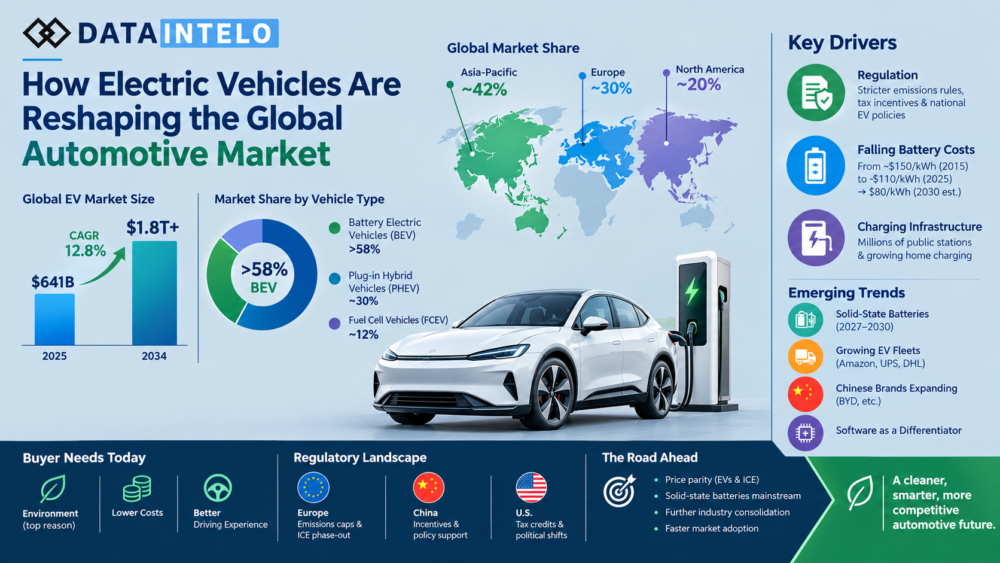
How Electric Vehicle Trends Are Reshaping the Market
Links to Amazon and other retailers on this page can be affiliate links or other sponsored advertising.
When you click and/or make a purchase, JADCOM Media LLC may earn a small commission. Thank you.
Due to technological advancements, the automotive sector has been experiencing a massive transformation over the last one hundred years. Electric vehicles have evolved from being a niche offering to being the default choice of transport in numerous markets. This transition is affecting consumer behavior and is redefining everything about the development, selling, and competition in the sector.
For the top executives of organizations observing this area, the statistics are rather obvious. However, the understanding of the underlying reasons and future trends in the auto industry is far more interesting.
Key Points of This Article
• The global electric vehicle market is projected to grow from $641 billion in 2025 to over $1.8 trillion by 2034, representing a compound annual growth rate of 12.8%.
• Battery electric vehicles currently hold more than 58% of the EV market share, with the Asia Pacific region leading global adoption at approximately 42% of market share.
• Lithium-ion battery prices have decreased from $150 per kilowatt-hour in 2015 to approximately $110 today, with projections reaching $80 per kilowatt-hour by 2030.
• Government regulations, including EU tailpipe emissions standards and China’s New Energy Vehicle policy, are primary drivers accelerating the transition from internal combustion engines to electric vehicles.
• Software differentiation is emerging as a key competitive factor in the EV market as battery technology becomes increasingly standardized across manufacturers.
Market That Is Evolving Much Faster than Expected
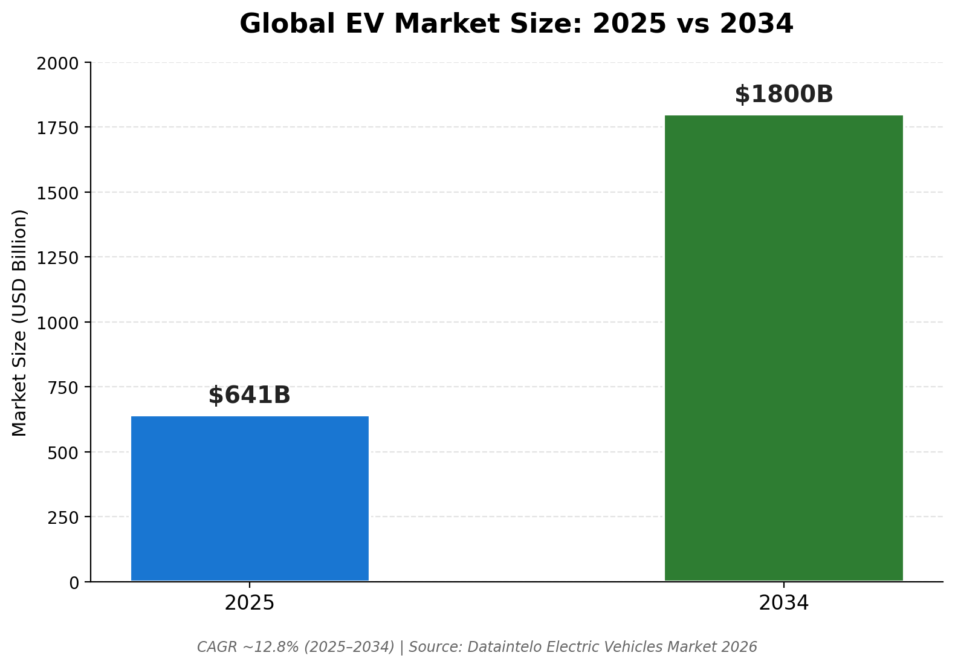
In a report by Dataintelo, the electric vehicles market in 2026 shows that the worldwide electric vehicle market size stood at about $641 billion in 2025. Consumer demand will drive the market to experience significant growth with the market size further expanding to surpass $1.8 trillion by 2034. In simpler terms, the CAGR (compound annual growth rate) of the industry will stand around 12.8%.
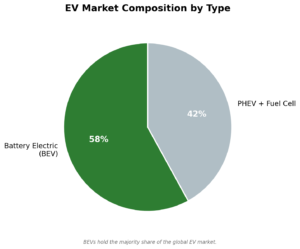
Battery electric vehicles represent the majority of the EV market and currently occupy a share of more than 58%. The rest is divided between plug-in hybrid electric vehicles and fuel cell vehicles depending on the level of infrastructure development.
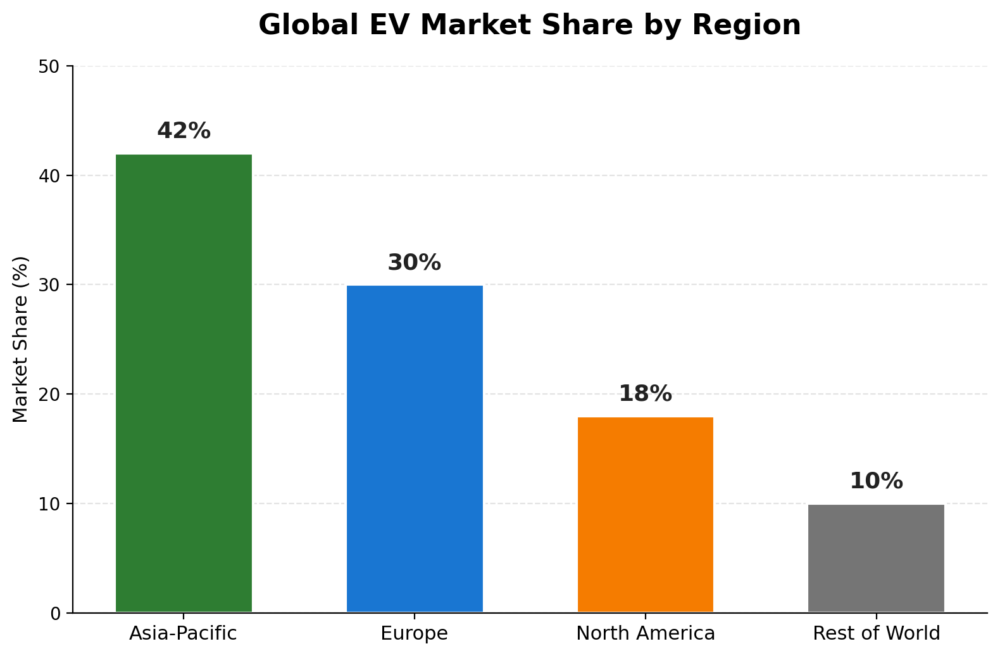
The Asia Pacific region is clearly the market leader, way out ahead of traditional automakers in the U.S., the European Union, the United Kingdom, and the rest of the world. They dominate with close to 42% of global market share.
China produces most of the world’s electric vehicles, powered by an aggressive government support and a strong automotive manufacturing base with significant manufacturing capability. Next in line is Europe, which is spurred on by strict emissions standards. North America lags behind both regions, despite the existence of incentives for EV buyers.
Global EV Market Distribution by Region
| Region | Market Share | Primary Growth Driver |
|---|---|---|
| Asia Pacific | ~42% | Government support and manufacturing capability |
| Europe | Second largest | Strict emissions standards |
| North America | Third largest | Consumer incentives and tax credits |
What Is Really Driving the Change?
A growing global environmental awareness is affecting EV adoption. There are three forces at work that are directly affecting the global electric vehicle market:
Regulation is forcing the issue
EU tailpipe emissions regulations are forcing car manufacturers to develop models with close to zero tailpipe emissions. China’s New Energy Vehicle policy links production support to electrification goals.
Meanwhile, U.S. tax credits that are tied to the Inflation Reduction Act have been driving consumer purchases for years, despite ongoing changes in the political environment surrounding such credits.
Battery prices are coming down rapidly
Battery technology continues to play an important role in the adoption of electric vehicles through downward forces on battery costs The price of the lithium-ion batteries used in electric mobility was about $150 per kilowatt-hour back in 2015 and is currently estimated to be about $110.
It is this reduction in price that has enabled the convergence in pricing between the electric cars and internal combustion engine cars. Cost projections are pointing towards a reduction to $80 per kilowatt-hour by 2030. This means battery electric vehicles will be priced on par with combustion engines for the $25,000-$40,000 segment.
Critical mass has been reached with charging infrastructure
There are now millions of public charging stations around the world, while home charging use has gone up significantly in developed countries. This is significant, given that it has been charging anxiety rather than range that has been the main obstacle to adopting EVs.
This growing demand for charging – and the continued capacity increases in urban centers and at home – coupled with the automotive industry producing vehicles with longer range ratings, all contribute to substantial market growth in the recent past, as well as ambitious targets for the future.
Three Primary Forces Accelerating EV Adoption
| Driving Force | Key Impact | Timeline |
|---|---|---|
| Regulatory Mandates | EU emissions standards and China’s NEV policy forcing zero-emission models | Active now through 2035 |
| Battery Cost Reduction | Price parity with combustion engines in $25k-$40k segment | Expected by 2030 |
| Charging Infrastructure | Millions of public stations eliminating charging anxiety | Ongoing expansion |
Recent Trends to Keep in Mind
Several trends are defining the direction of this industry:
The time of solid-state batteries is coming
Toyota, Samsung, and Quantum Scape are among companies that are working on future batteries which are said to have a lot of advantages compared to conventional batteries in terms of energy storage and charging speed. Once such cells become commercially available in 2027–2030, they will help to resolve problems with range anxiety and charging anxiety.
Commercial vehicles can especially take advantage of solid-state battery technology. With their higher energy density and fast charge times, operational costs for fleets can be impacted favorably in the long term. This is a key factor in the transport sector.
Both of these areas can be major contributors to reducing environmental pollution as global environmental regulations are expected to continue being tightened.
Electric fleet is growing rapidly
Such major delivery companies as Amazon, UPS, and DHL are making efforts to convert their fleets to EVs. In addition to being eco-friendly through a reduction in carbon emissions, these key players see it also as a wise business move.
In many parts of the world, the cost per mile using electricity is already less than that of diesel. Technological innovation will continue to enhance the use case of zero-emission vehicles and should help fuel continued rapid growth in the sales of electric vehicles.
Chinese companies are entering new markets
By scaling up production so actively, brands like BYD are able to sell their vehicles even 20% cheaper than established automakers. This is putting pressure on the entire industry in terms of pricing.
Software is becoming the actual differentiator
With increasing standardization of batteries, the competition between companies comes down to the software they provide. Consumer interest in the overall experience in a passenger vehicle goes far beyond the electric motor.
Auto brands see these experiences as major factors in the competition to sell the EV vehicle type. From battery management, to nav systems, to driver interfaces – and beyond – consumer preferences will play a crucial role in software development.
Emerging EV Technologies and Market Entry Timeline
| Technology/Trend | Key Advantage | Expected Availability |
|---|---|---|
| Solid-State Batteries | Higher energy density and faster charging | 2027-2030 |
| Electric Commercial Fleets | Lower cost per mile than diesel | Currently expanding |
| Software Differentiation | Enhanced user experience and battery management | Active development |
Factors for Growth That Senior Executives Should Monitor
When considering the areas of investment, there are several underlying factors that play a greater role compared to mere growth figures.
Political stability of government incentives
Governments can change and so do their policies. Markets where there is a strong political commitment to subsidies through consistent federal government regulations will have a more stable curve compared to markets that depend on temporary incentives.
Material supply chains
Lithium, cobalt, and nickel are available in limited markets and are at the heart of how batteries store and deliver electric power. This situation can lead to geopolitical risks for manufacturers.
Firms that take a leadership position and invest in battery recycling and alternatives such as lithium iron phosphate can contribute to reducing the future risks of materials’ shortages.
Sensitivity of consumers to prices
Even though younger people are more willing to use electric vehicles, price remains the factor that determines who becomes an electric customer. Mass market and not luxury market holds the key to future growth.
Growth of electric two-wheelers and commercial trucks
Passenger cars attract the most attention but electric two-wheelers and commercial trucks grow faster relatively. Electric scooters and mopeds have become popular means of transportation in parts of Asia. These changes still do not catch the attention of western media.
One difference here is the growth of e-scooter sharing services like Lime, Bird, Spin, Veoride, and the offering from rideshare platform, Lyft. E-scooter sharing seems to be continually growing across the United States.
Critical Risk Factors in EV Market Expansion
| Risk Factor | Impact Area | Mitigation Strategy |
|---|---|---|
| Government Policy Shifts | Market stability and incentives | Focus on regions with consistent regulations |
| Material Supply Chains | Lithium, cobalt, nickel availability | Invest in battery recycling and alternatives |
| Price Sensitivity | Mass market adoption | Target $25k-$40k consumer segment |
Current Adoption Trends: Buyer Needs Today
Buyer opinions seem to have changed significantly since 2016. According to studies, the majority of buyers under the age of 35 who live in developed countries are now interested in purchasing an electric car – something that was far from reality in 2020.
However, different segments of the population show different levels of readiness to buy electric cars. Urban buyers with access to home or workplace chargers tend to switch to EVs much quicker than rural and suburban buyers who are concerned with long-range driving capabilities.
Saving the environment is the primary reason for purchasing electric cars today, but saving money and better driving experience are not far behind. It is worth taking into consideration when marketing EVs.
Regulatory Context: A Patchwork That’s Gradually Coordinating
The approach toward electrification differs from one region to another, with national governments nearly always adopting their own approaches. This makes things difficult for global manufacturers.
Europe’s approach involves an extensive use of caps on greenhouse gas emissions and phased bans on the use of combustion engines in automobiles. There are many nations in Europe which have set deadlines from 2030 to 2035 for banning the sales of new gasoline-powered vehicles.
China’s approach is based on offering incentives to manufacturers along with preferential treatment to the owners of electric vehicles in metropolitan areas. The United States uses customer tax credits, but the viability of such credits is contingent on the political climate.
In this scenario, companies need to be flexible in their product strategy according to the region in which they operate.
Regional EV Regulatory Approaches Comparison
| Region | Policy Approach | Key Deadline |
|---|---|---|
| Europe | Emission caps and combustion engine bans | 2030-2035 |
| China | Manufacturer incentives and urban preferences | Ongoing implementation |
| United States | Consumer tax credits (politically variable) | Subject to political changes |
Most Important Insights to Remember
#1 Market growth projections indicate unprecedented expansion with the global EV market growing from $641 billion in 2025 to over $1.8 trillion by 2034, driven by technological advancement and regulatory pressure across all major automotive markets.
#2 Battery cost reduction is the critical enabler of mass adoption as lithium-ion prices decrease from $150 per kilowatt-hour in 2015 to a projected $80 by 2030, bringing EVs to price parity with combustion engines in the crucial $25,000-$40,000 consumer segment.
#3 Asia Pacific dominance reshapes global automotive competition with the region controlling approximately 42% of market share through aggressive government support and manufacturing scale, particularly China’s production capabilities and policy framework forcing traditional automakers to adapt.
#4 Software differentiation replaces hardware as the competitive battleground since battery technology standardization shifts manufacturer focus to user experience, battery management systems, and integrated software features that distinguish brands in an increasingly commoditized market.
#5 Commercial fleet electrification accelerates faster than consumer adoption because major delivery companies like Amazon, UPS, and DHL recognize lower per-mile operational costs and regulatory compliance advantages, making electric commercial vehicles economically superior to diesel alternatives in many markets.
Roadmap for the Future
Electric cars are not some distant hope. Instead, they are an immediate reality which is currently transforming supplier interactions, production facilities, and competition in the entire automobile industry.
In the coming years, the industry will see price parity for electric and gas-powered vehicles in the consumer market, solid state batteries being more widely used, and further consolidation as smaller companies face challenges of competing against established producers.
For the leadership of this industry, the issue will not be about whether the process of electrification will continue. It will be about how quickly they will be able to catch up with the rapidly changing market.
FAQs
How do electric two-wheelers compare to passenger vehicles in terms of market growth?
Electric two-wheelers and commercial trucks are experiencing faster relative growth rates than passenger cars, particularly in Asian markets. Electric scooters and mopeds have become dominant forms of urban transportation in many parts of Asia, while e-scooter sharing services like Lime, Bird, and Lyft are expanding rapidly across the United States.
What role does battery recycling play in the future of EV sustainability?
Battery recycling is becoming increasingly critical as manufacturers seek to reduce dependence on geopolitically sensitive raw materials like lithium, cobalt, and nickel. Companies investing in recycling technologies and alternative battery chemistries like lithium iron phosphate are better positioned to mitigate future material shortages and price volatility.
Why are Chinese EV manufacturers able to offer significantly lower prices than established automakers?
Chinese brands like BYD achieve pricing advantages of up to 20% below established automakers through aggressive production scaling and strong government support. This pricing pressure is forcing the entire global industry to reconsider their cost structures and manufacturing strategies to remain competitive.
How does workplace charging infrastructure differ from home charging in terms of adoption impact?
Urban buyers with access to both home and workplace charging stations demonstrate significantly faster EV adoption rates than suburban or rural buyers who rely primarily on public charging networks.
Workplace charging eliminates the need for longer charging sessions during the day and provides additional convenience that accelerates purchase decisions among employed urban residents.
What specific advantages do electric commercial fleets offer beyond environmental benefits?
Electric commercial fleets provide lower operational costs per mile compared to diesel vehicles in many markets, with electricity consistently proving cheaper than fossil fuels.
Additionally, fleet operators benefit from reduced maintenance requirements, longer vehicle lifespans for electric drivetrains, and improved compliance with urban emissions regulations that may restrict diesel vehicles in city centers.
Article Glossary
Battery Electric Vehicles (BEVs)
Vehicles powered entirely by electric batteries with no internal combustion engine, representing more than 58% of the current EV market share.
Compound Annual Growth Rate (CAGR)
A measure of an investment’s mean annual growth rate over a specified period of time longer than one year, projected at 12.8% for the global EV market through 2034.
Solid-State Batteries
Next-generation battery technology with higher energy density and faster charging capabilities compared to conventional lithium-ion batteries, expected to become commercially available between 2027 and 2030.
New Energy Vehicle (NEV) Policy
China’s regulatory framework that links production support to electrification goals, driving manufacturers to develop zero-emission vehicles.
Range Anxiety
Consumer concern about the limited distance an electric vehicle can travel before requiring recharging, increasingly addressed by improved battery technology and expanded charging infrastructure.